
‘Balkanization’ and What We can Learn from History

Post-War Background
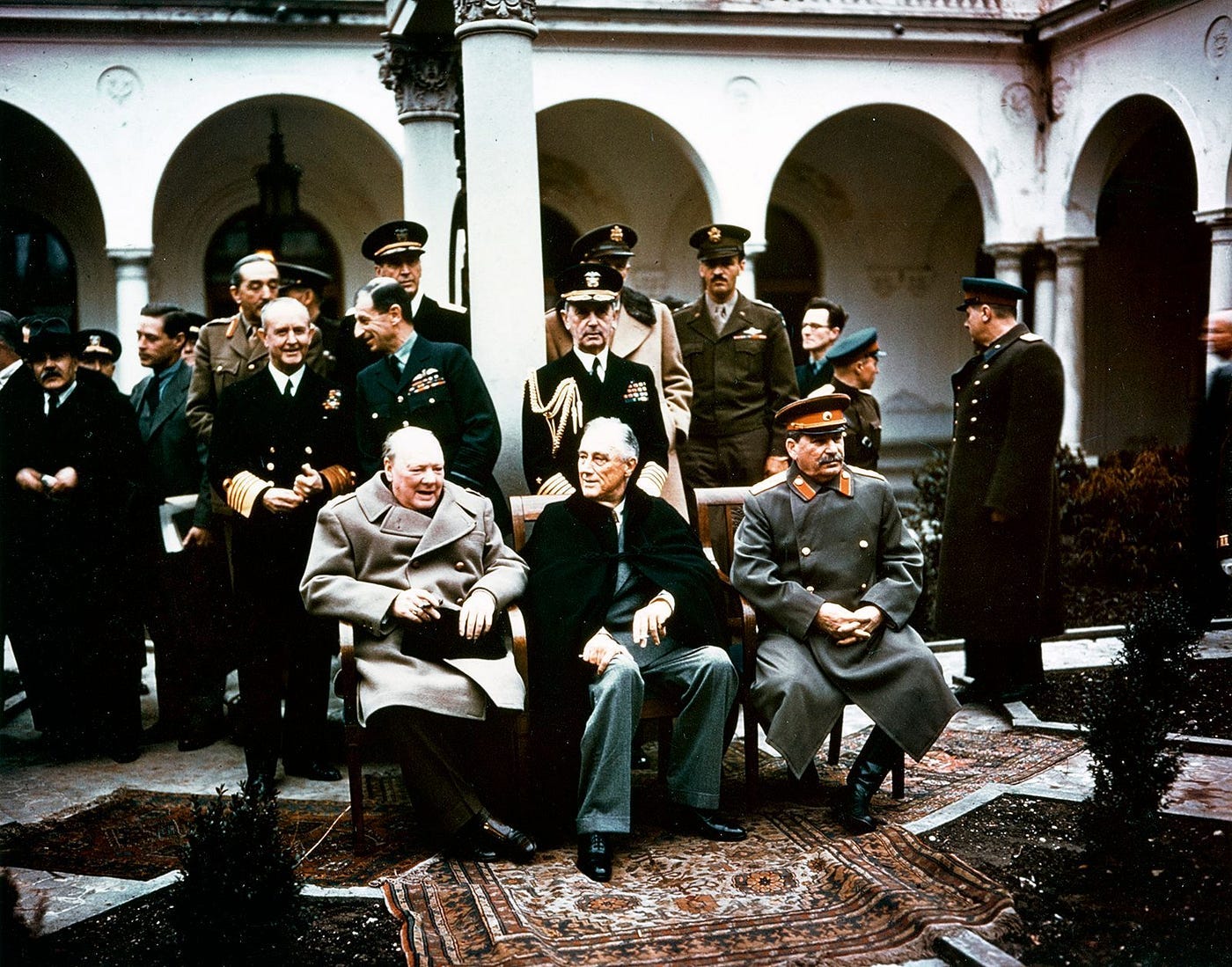
Following the Second World War, the globe was embroiled in a bipolar power struggle between NATO in the west and the Warsaw Pact in the east. The United States had inherited the western prestige of the now deteriorating British Empire, and the Union of Soviet Socialist Republics had demonstrated a remarkable ability to turn underdeveloped feudal states into fully functioning industrialized metropolises. Despite being heavily damaged during the war, the USSR’s ability to quickly rebuild and modernize made it a worrisome opponent to the colonial west and its expansionist policies. As a result, the Soviet bloc offered the countries in the East an alternative to the market capitalism of the west. Soviet bloc countries could liberate their population from feudal hierarchy, while rapidly industrializing themselves and remain relatively independent on an economic basis.
The need for such independence was fueled by the colonial history of Europe, the United States, and Imperial Japan. This rapid colonialism during the “Age of Discovery” was part and parcel of the budding international mercantilism that began in the independent republics in Italy (ie Florence and Venice), and spread to the Netherlands, Great Britain, and Castilian Spain. The splintering of the Holy Roman Empire, and its exacerbation thanks to the Protestant Reformation, weakened the influence of Catholic economic teaching, in particular the prohibition against usury. This allowed banking families (the Medicis and Rothschilds in particular) to rise to such prominence, as to directly influence political forces through funding wars and other activities. At the same time, advances in maritime travel, and the discovery of sugarcane, cocoa, caffeine, tobacco, and opium (as well as other materials) gave economic incentive for European powers to dominate as many colonies in Asia, Africa, and the “New World” as possible. The Trans-Atlantic Slave Trade was also an economic strategy to provide the labor needed to farm and produce these valued goods throughout Europe and America.
The world is still reeling from the ongoing effects of that widespread abuse. No wonder several countries in Africa, Asia, and Latin America wanted to avoid market capitalism like the plague. China, especially, remembers the trauma of the “Opium Wars”, where the British purposely got the population addicted to opium in order to keep them economically docile and independent. The ordeal heavily weakened the Qing Dynasty, and lost them Hong Kong, which was under British control until 1997. To this day, China remembers this period as the “Century of Humiliation”. This was only made worse after World War II, when the United States made Japan a political satellite for western interests. Japan was, of course, the Empire that brutalized Korea and Eastern China during the Asian Theatre of the war. Now, the constant threat of a reprise of such colonial brutality was right at their doorstep.
Again, it is little wonder why Marxist-Leninist revolutionaries popped up in China, Korea, Vietnam, Afghanistan, Cuba, and other countries in the so-called “global south”. This alternative allowed these countries to rapidly modernize with the help of the USSR, in order to provide a necessary buffer against the capitalist machine which was understandably perceived as exploitative, colonial, and imperial.
The Non-Aligned Movement
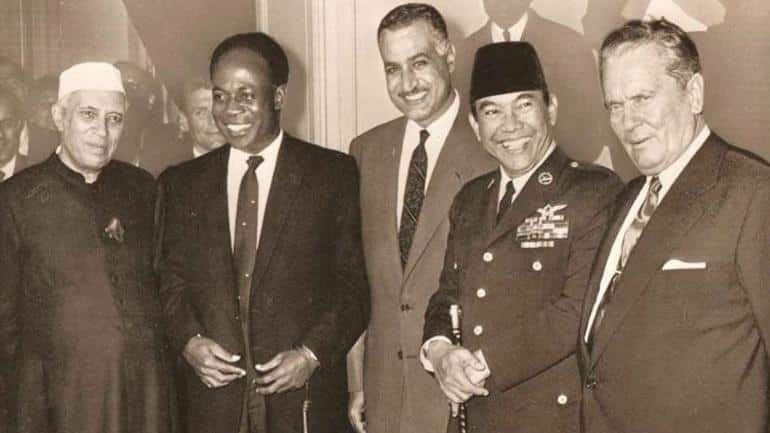
In the midst of this bi-polarization, there were was a movement of (mostly) socialist states who sought to form a “third option” outside of the two blocs. This would become known as the “Non-Aligned Movement”, and was initiated in the wake of the US-USSR proxy war in Korea. From September 1–5, 1961, The 1st Summit of the Heads of Government of the Non-Aligned Movement met in Belgrade. The host country was the Socialist Federal Republic of Yugoslavia, led by Joseph Broz Tito, who had previously had a falling out with Joseph Stalin and the USSR.
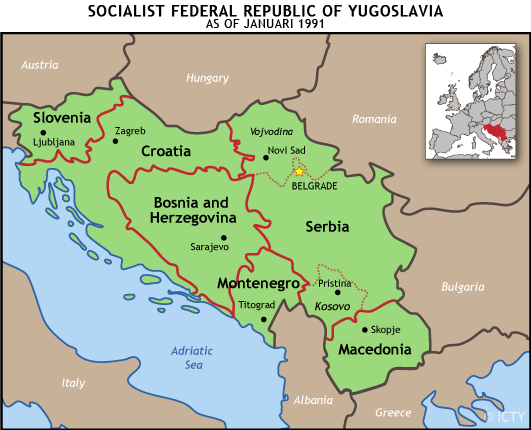
Socialist Yugoslavia was a multi-ethnic union in the Balkans, whose borders were home to Orthodox Christian Serbs, Macedonians, Muslim Bosniaks, Catholic Croats, Aromanians, Albanians, and many other minority groups. Like the Soviet Union, Yugoslavia was made up of smaller socialist states. These included the Socialist Republics of Slovenia, Croatia, Serbia, Bosnia and Herzegovina, Montenegro, and Macedonia. It was a pluralistic union that echoed the Ottoman province of Rumelia. After the collapse of the Austro-Hungarian and Ottoman Empires following World War I, the Kingdom of Serbia merged with other southern Slavic communities to form the Kingdom of the Serbs, Croats, and Slovenes which was later renamed the Kingdom of Yugoslavia. The country was occupied by Hitler’s forces during World War II, and was liberated in part by Tito’s forces, whose victory led to the establishment of the Socialist Federal Republic of Yugoslavia. Post-war, the SFR was largely harmonious under Tito and many former Yugoslavs look back to his leadership with nostalgia and admiration (especially when compared to what transpired after he died). In a world where many feel that homogeneity is a must for a healthy society, one only needs to look at Yugoslavia under Tito. Different families are capable of cohabitation. Tito’s Yugoslavia is also a lesson to those in the west who insist on the superiority of liberal democracy, and look down on countries who do not follow in that tradition.
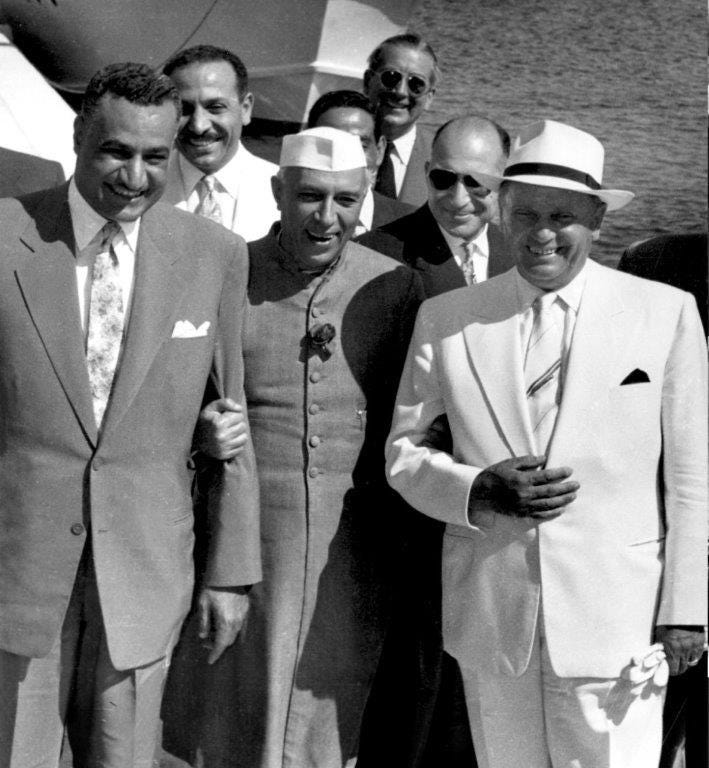

Another important country represented in the Non-Aligned Movement was Gamal Abdel Nasser’s United Arab Republic, which was a union of Egypt and Syria. The UAR was another Socialist reprise of Ottoman coexistence, which took some of its cues from the Ba‘ath Party in Syria, which was outlined by Michel Alfaq, an Orthodox Christian Pan-Arabist. The word Ba‘ath comes from the Qur’anic root bā-‘ayin-thā which has the broad connotation of God breaking one free from restraint.
Nasser took the helm and became a leading figure in the Arab World, toppling King Farouk in Egypt, and making the country independent of British control. His nationalization of the Suez Canal in 1956 sparked panic from the west. Luckily, President Dwight D. Eisenhower had the sense not to attack Egypt, perhaps learning from his involvement in the 1953 ousting of Mohammad Mosaddegh for nationalizing Iranian oil.
In the eyes of NATO foreign policy, the unforgivable sin of a developed (or even a developing) nation is to not participate in their system of international commerce. If a commercial good becomes a nationalized commodity, that is obviously bad for international commerce and the international bankers. Throughout the 20th century, NATO has conducted several operations in the global south to damage local economies, sow local dissent, and even participate/ aid in regime change. This track record is why I can’t take pearl-clutching westerners seriously when they talk about China or Russia being “authoritarian”. Or when they wonder why North Korea runs nuclear tests, or why Iran wants to build a nuclear bomb. They’ve seen what happens to countries, opposed to NATO interests, who do not have the means to defend themselves. Recent examples would be what happened to Gaddafi’s Libya, or Saddam’s Iraq. Those were two countries who did not have nuclear deterrants. To accept “liberal democracy” would be essentially a national security catastrophe. In a world where the CIA exists as it presently does, every country not aligned with it’s agenda must be secure enough to defend itself. Free discourse is a privilege of living in a country powerful enough to afford local dissent. This isn’t an endorsement of authoritarianism, just an observation. The rest of the world is on the defensive. It’s the reality.
Breakup of Yugoslavia & Modern Parallels
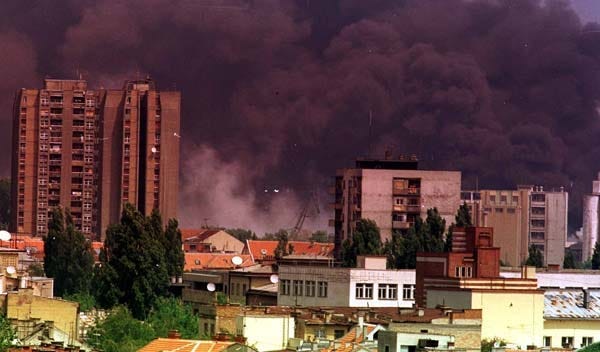
Tito died in 1980, and after his death, the economy of Yugoslavia gradually degraded. A large component of the issue was Tito’s mistake to borrow from western banks to fund industrialization in Yugoslavia. It was an attempt to avoid outright central planning, which can have catastrophic effects on rural communities, but it eventually backfired. While Tito was able to manage the debt while he was in power, and Yugoslavia thrived in the 60s and 70s, his successors were much less able. Eventually the debt owed to western creditors became so large that the country’s economy began to severely plummet. As economic conditions worsened, ethnic nationalism among the local republics became increasingly hostile. In 1991, Slovenia, Croatia, and Macedonia declared independence. Germany quickly recognized an independent Slovenia and Croatia, and the rest of the United Nations did so in 1992.
Bosnia and Herzegovina quickly declared its independence in 1992, and the war that followed was incredibly brutal. Serbia, one of the six republics in Yugoslavia, was led by Slobodan Milošević. There is nothing that NATO loves more than sparking nationalist uprisings in the global south, and Milošević was no exception. At first, he was tolerated by the Clinton administration, until it became clear that his ultimate aim was to keep Yugoslavia in tact. Milošević became the designated “bad guy” in the media, as reports of Serbian-led atrocities against Bosniaks (Bosnian Muslims) and Croatians flooded western media outlets. This of course completely glossed over the atrocities committed by the NATO-backed KLA (Kosovo Liberation Army), as well as atrocities by Bosniaks and Croatians against Serbs. A glaring example of this hypocrisy can be seen in the reporting on Operation Storm, which was framed in the media as Croatians fighting for freedom, but was in reality an orchestrated ethnic cleansing against Serbs, Roma, and other minorities in Croatia.
The press levied public support in the West summarily against Milošević, which increasingly began to paint him as the next Adolf Hitler. It is true that Serbian committed atrocities against minority groups, but they were far from the only players. In fact, NATO’s bombing of civilian infrastructure in Serbia and Kosovo only added to the carnage. NATO’s intervention was not a humanitarian rescue of displaced persons, it was a geopolitical strategy to secure liberal pro-Western republics in the Balkans, especially following the breakup of the Soviet Union in 1991.
The same playbook exists today with how the war in Ukraine is treated by the Western media. Putin and Russia are summarily condemned, much like Milošević and Serbia. And like the Yugoslav wars, the atrocities committed by the “pro-NATO” side are completely ignored. Zelenskyy’s Ukraine is seen as a stronghold for democracy that must be preserved, even though the current government exists because of the Maidan Revolution, where western powers influenced a coup of the democratically elected government already in place. The problem was that the pre-2014 Ukraine ended up choosing to opt out of NATO, and stay closely allied with Russia.
And just for the sake of clarity, I do not praise or endorse Putin or Milošević. I do not, however, see them as the reincarnations of Hitler they were/are presented to be.
The fact of the matter is that the west has had a major hand in excising Ukraine from Russia, even though the Donbas region in Ukraine’s eastern frontier houses many individuals who are not only supportive of a close relationship with Russia, but identify as Russians themselves. The harsh treatment of Donbas Ukrainians by the current Ukrainian government is also conveniently left out of western legacy media. Ukrainians and Russians are definitely distinct on technical level, but they both undoubtedly share a close heritage as descendants of the Kievan Rus. This is also the case in the Balkan Slavic communities. Serbian and Croatian are so close to each other that the language was historically called “Serbo-Croatian”. Montenegrin and Bosnian are also included in this. Another South Slavic language is Bulgarian, which is the most direct descendant of Old Church Slavonic. OCS is sometimes even referred to as “Old Bulgarian”. Since World War II, there has been a dispute between Bulgarians and ethnic Macedonians about whether or not the Slavic “Macedonian” language is really just a dialect of Bulgarian. After all, they share some unique features that are not shared with any other Slavic language. The South Slavs, and even their western and eastern cousins, are all closely related. The differences between them are largely incidental and political, rather than any significant linguistic or ethnic divide.
Balkanization as a Term
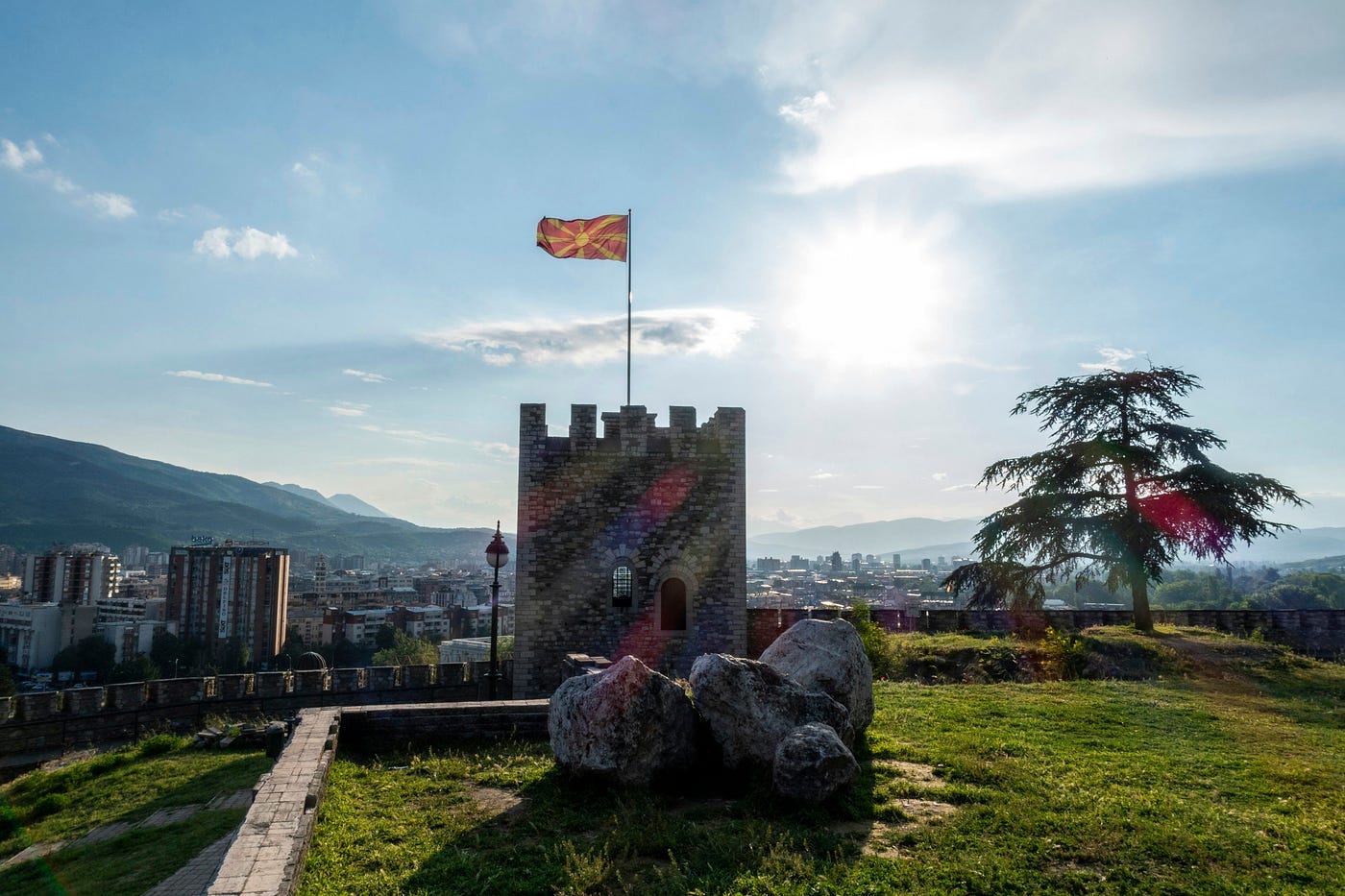
In view of the carnage waged in the breakup of Yugoslavia, the use of ‘balkanization’ as a political protocol is quite unsettling. And yet, we consistently see it at play throughout the world, often times in the interest of western powers. I already spoke about Russia and Ukraine, which were both republics within the Soviet Union. China comes to mind, as many westerners are quick to support the cause of Taiwan or resistance movements in Hong Kong. Many in the west would love to see an independent and western-aligned Tibet, and love to pontificate about the Uyghurs in China’s Xinjiang province despite getting most of their information about them from the United States government. At the same time, those westerners in question have, until very recently, harbored Zionist sensibilities, and levy support for the Iranian Pahlavi family which was rejected by local Iranians more than once. The first modern nation to be “balkanized” was the Ottoman Empire. In the past one hundred years, it has simply been unacceptable to be a large country that refuses to participate in the international banking system. To be financially independent is the crimson sin of the age.
This, however, is changing ever so slightly. My hope for the world is that the United States and NATO cease to be the sole superpower, both in terms of military influence and especially in commerce. With the recent cooperation inside the BRICS-sphere, including a surprising alliance between India and China, there might be some hope of international cooperation rather than western domination. Perhaps then, the west could heal.
Nationalism is a slippery slope, that once weaponized, can dehumanize anyone who is seen as “other”. The first chapter of Fr. Paul Tarazi’s The Rise of Scripture lays it out beautifully. Prior to Alexander the Great, the cultures Ancient Near East had an understanding that everyone inhabiting the same stretch of land are, in a sense, brethren of that land. We see this in scripture. Israel “inherits” the land of Canaan, but they still co-exist with Philistines, Edomites, Ishmaelites, Hittites, and others. That’s not to say it was peaceful, but there was no sense of one dominating the other. Interestingly, even Homer’s Iliad, there are no “Greeks” per se. You have the Danaans, Argives, and Achaeans who are allied against the Trojans. There’s no sense of the “Pan-Hellenism” in the later Greek versus Barbarian sense you get with the Athenian philosophers. The danger in the latter is that you end up stripping the outsider of their shared humanity, and local heritage. That’s the beauty of the model of Yugoslavia. It played more into the etymology of nation, which comes from the same Latin root where we get “nativity”. It is the land in which you are born. You could be a Roma from Skopje and still be a Yugoslav. Mother Theresa was an Albanian by ethnicity, but was born in Skopje under the Ottoman Empire. She was just as Ottoman as Osman I! Serbs, Croats, and Bosnians were also Yugoslavs. It’s more scriptural that way.
At the end of the day, we all share the same ’adamah as our mother and we all have the same Father in heaven. The imposition of identity as a mechanism of control and suppression against our neighbors has no place in the table fellowship of Paul the Apostle. There, your identity means nothing. You are simply a brother or sister in Christ, because Christ becomes the identity as the heir to his Father’s house. We are simply invited to the table, as slaves of Christ, so that in Christ we may participate in table fellowship in salām.