
BOOK REVIEW — Roots of Scripture

Purchase here
There is much talk in contemporary religious discourse about the so-called “crisis of faith” which refers to when someone is in the process of questioning deeply held convictions about God or their particular religion/ denomination. Naturally, this is typically a painful experience. What you previously trusted in might not indeed be “trustworthy”. Your church might not be the infallible harbinger of orthodoxy, and your God might not even “exist”. Your religious efforts are potentially meaningless. This is crushing for most people. In Roots of Scripture, Dr. Nicolae Roddy postulates that the seed that planted what became the Old Testament was this very real crisis of faith experienced by the would-be Hebrew prophets (in reality, priests) following the brutal annihilation of Jerusalem and her temple at the hands of the Babylonians in 586 BCE.
Those “prophetically influenced priests” witnessed and chronicled the decadence of the Israelite and Judahite kings, leading to the destruction of Samaria (in the 8th century BCE), which acted as a disturbing foretaste of the critical destruction of Judah almost two centuries later. This can be seen in the canonical ordering of the Twelve Minor Prophets which begins with Hosea (set in Samaria before its fall) through Micah, Habakkuk, and Zephaniah which are set at the brink of Jerusalem’s fall, followed by Haggai, Zechariah, and Malachi which are post-exilic. This is also expressed in the sequence of the three “major” Judahite prophets: First-Isaiah (set before the fall of Samaria), Jeremiah (a priest from Anathoth persecuted for preaching God’s judgment against Judah), and Ezekiel (a priest exiled in Babylon, the son of Buzi which in Hebrew means my shame).
Throughout the book, Dr. Roddy frames the prophetic literature as responding to the question of why Yahweh would abandon his city and temple? Since they couldn’t accept that Yahweh, their gibbor (mighty warrior), could be overpowered by the Babylonian gods, they were forced to reflect on the fact that Yahweh not only allowed those lesser gods to destroy the temple — he actively brought it about. In order to make sense of this catastrophe, and to render a lesson out of the ordeal, the priests embarked on a scathing self-critique of not only their own history and past sins, but of every facet of society from the palace-temple complex at the very top to individual ego at the bottom. The book convincingly takes the reader through the major and minor prophets, offering direct examples that offer critical insight into their pedagogical intention.
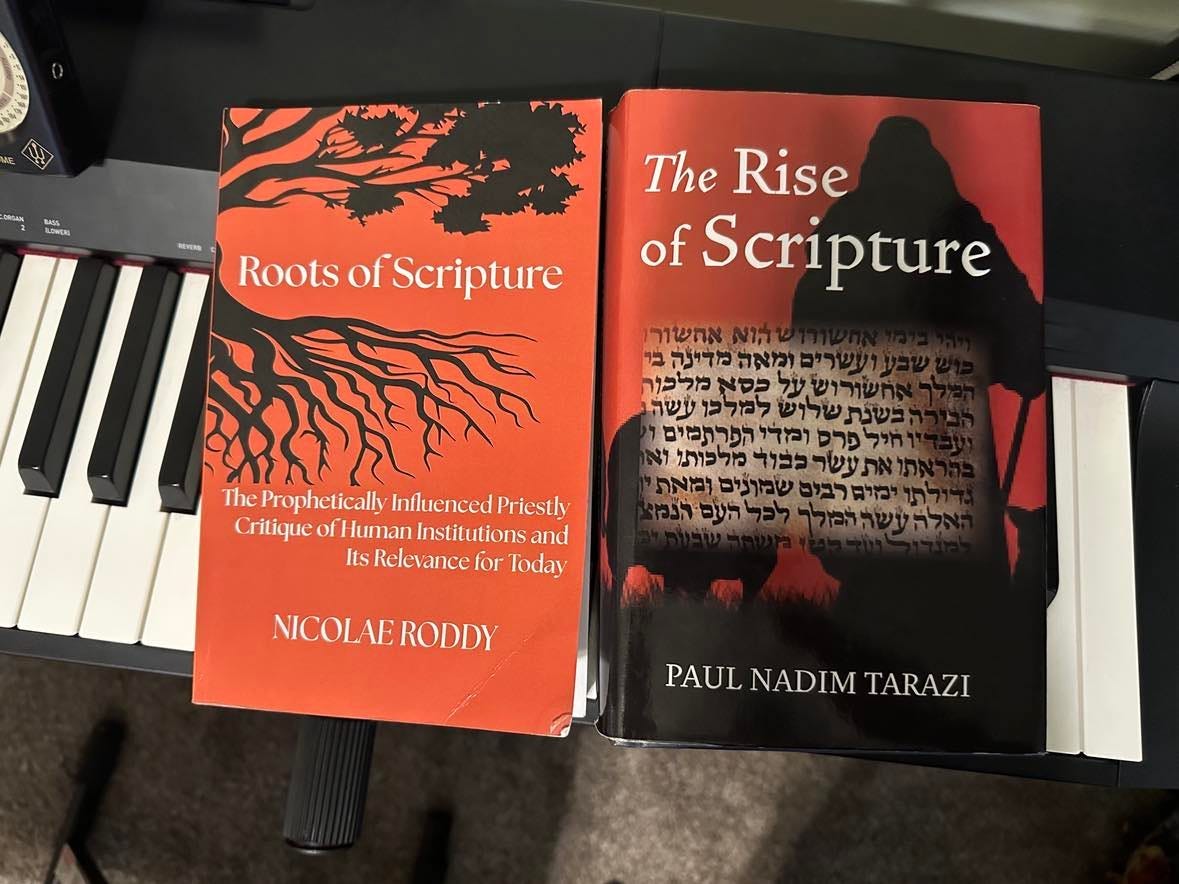
As the title suggests, Roots of Scripture functions as an expanded introduction to the Very Rev. Dr. Paul Nadim Tarazi’s 2017 magnum opus The Rise of Scripture. Tarazi’s book not only offers a thesis on the Bible’s origins but subsumes his entire academic career into a codified compendium. Dr. Roddy wrote the foreword to The Rise of Scripture so it is only fitting that his book would be so closely tied to it. He was, after all, one of Tarazi’s most notable students. Just as Rise was Tarazi’s academic compendium, Rootsfunctions very much as Roddy’s. He has taught courses on the prophetic literature for a few decades and has also participated in archaeological digs in Bethsaida on the Syrian side of the Sea of Galilee. Likewise, he incorporates both aspects of his expertise into this volume. In so doing, he interacts with current biblical scholarship and refrains from openly deviating from it which will likely be appreciated by readers already acquainted with the field. This approach does differ from Tarazi’s thesis in The Rise of Scripture which presents a largely novel thesis on the Bible’s origins, placing it in the third century BCE as a polemic against Hellenism and the tyranny of the Seleucids. For Dr. Roddy’s immediate reflection on that thesis, see his paper on the subject. Despite this different angle, Roots still works as an introduction to Rise in that it seeks to dig deeper into the underlying factors that would lead to not only the prophetic literature, but the Torah and Ketubim as well. Therein explains the title — if Rise is about the Bible’s immediate origins as a codified and redacted literature, Rootschronicles the seeds being planted in the Judahite priestly elite. Perhaps Roots can indeed act as a bridge between contemporary academia and Tarazi. After all, contemporary scholarship is in virtual agreement that the final redaction of the Hebrew Bible as we know it was a product of the Hellenistic period, with the latest book, Daniel, being dated to as late as the mid-second century BCE.
Lastly, I would like to express my appreciation that Dr. Roddy not only offers a comprehensive study of the prophets, he also demonstrates how their self-critical message applies to us today. Our current landscape of late-stage capitalism, far-right nationalism, religious indifference to the poor, faith in martial strength, the worship of demagogues and the monuments we erect — were demonstrated, by the Hebrew prophets, to be mechanisms of self destruction. As the book of Daniel so concisely demonstrates, all empires come to an end no matter how powerful they are. The mark of a healthy society is not military might and impressive structures, but internal peace, order, and care for its most vulnerable members.
Congratulations and many thanks to Dr. Nicolae Roddy for this important contribution to Biblical studies. A faithful son of Romania, he follows in the footsteps of the great Romanian Orthodox Biblical scholars like the priests Fr. Vasile Tarnavschi and Fr. Vladimir Prelipcean — the latter being a professor of Semitic languages and teacher to Fr. Paul Tarazi during his studies in Bucharest. It all comes full circle with Dr. Roddy, who not only revives the seriousness of those scholars in the Romanian Orthodox Church but also furthers the school established by Tarazi through his faithful leadership of OCABS.
La mulți ani, Dr. Roddy!